
Picture this: a guest messages your hotel at 9 PM on a Friday night. They want to know if you have a room available for the long weekend. No one replies until Saturday morning. By then, they have already booked on MakeMyTrip.
This happens at hundreds of independent hotels across India every single day.
Not because the hotel didn't want the booking. Because no one was around to reply fast enough.
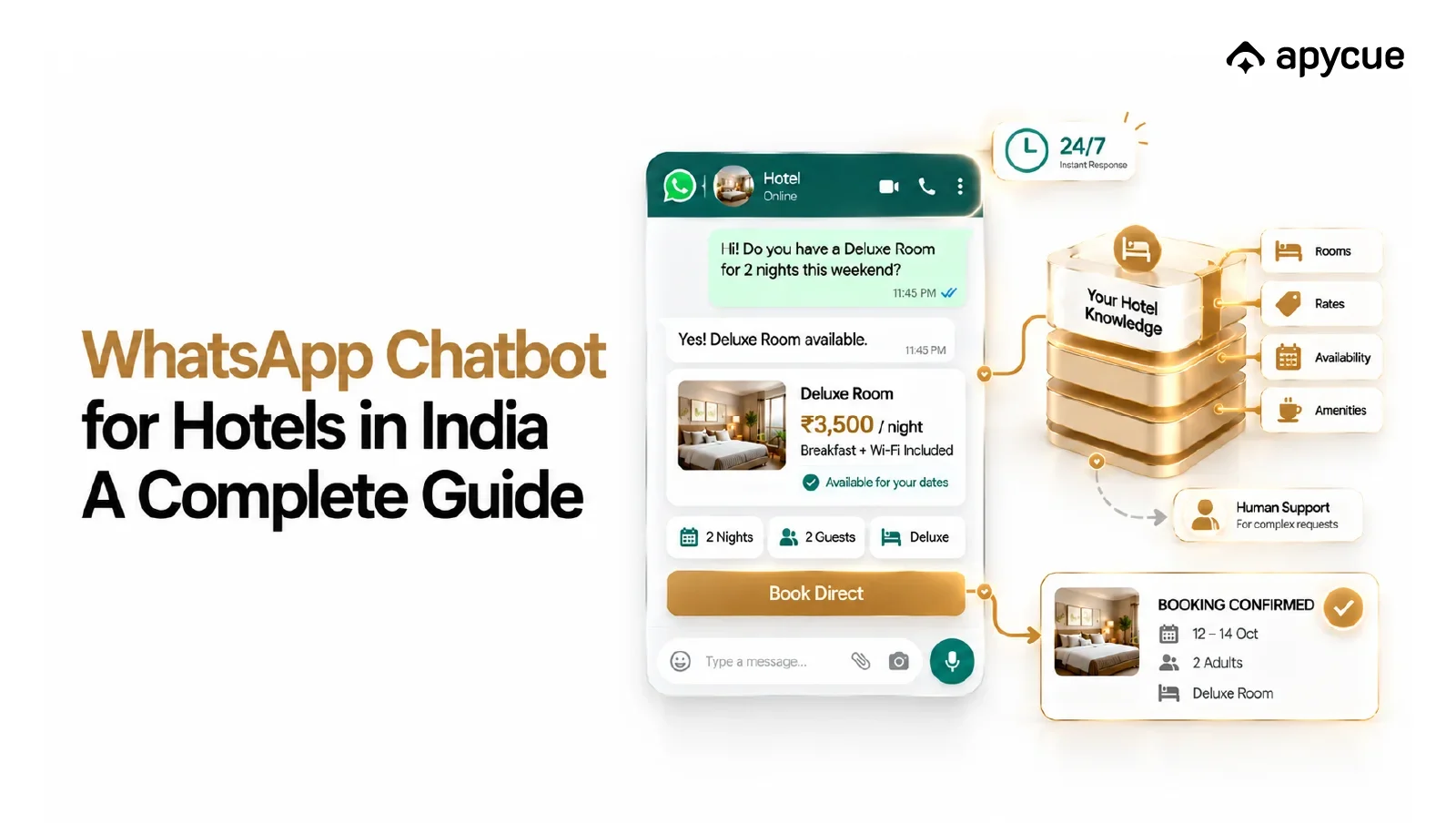
A WhatsApp chatbot for hotels fixes exactly this problem. It responds to every message the moment it arrives, answers guest questions, shares rates, and sends a booking link, all without your team lifting a finger.
This guide covers everything you need to know as a hotel owner: what a WhatsApp chatbot actually does, what separates a good one from a bad one, why most hotel setups fail within the first two months, and how Indian hotels are using one to bring in direct bookings they used to lose to OTAs.
Want to see how an AI chatbot could work for your hotel?
Book a free call with the Apycue team and we'll walk you through what's possible.
Book a Free CallWhat is a WhatsApp Chatbot for Hotels?
A WhatsApp chatbot is an AI assistant connected to your hotel's WhatsApp number. When a guest sends a message, the chatbot replies automatically, any time of day or night, without needing your staff to be present.
This is different from the WhatsApp Business app most hotels already use. The free app lets you set a single away message and that's it. A chatbot can hold a proper back-and-forth conversation, answer specific questions about your hotel, quote rates for exact dates, and guide the guest toward a booking.
That difference matters a lot in hospitality. When a guest asks "do you have a sea-facing room for 3 nights from December 24?", they are not looking for a generic reply. They want to know what's available, what it costs, whether breakfast is included, and how they can confirm it. A hotel-grade chatbot handles that full exchange on its own.
Why Indian Hotels Need This Right Now
India has over 500 million active WhatsApp users. For independent hotels in India, this isn't a background statistic. It's the channel your guests are already using to ask about rooms.
When a traveler is planning a trip to Goa, Coorg, or Jaipur, they're not picking up the phone. They're sending a WhatsApp message. If your hotel takes three or four hours to reply, they're already booked somewhere else.
Here's where it gets costly: most of those lost bookings don't go to another hotel. They go to MakeMyTrip or Booking.com because those platforms respond instantly. The OTA gets the booking, charges you 15 to 25% commission, and keeps the guest's data.
If you had replied to that same inquiry within 60 seconds, you could have converted it to a direct booking. No commission paid. The guest stays in your system for future campaigns.
The maths is simple. A hotel doing ₹50 lakh per month in revenue and paying 18% OTA commission is spending ₹9 lakh a month just in fees. Shifting even 15 to 20% of that traffic to direct channels saves lakhs every year. A WhatsApp chatbot is one of the most direct ways to start that shift, because it's already on the channel your guests prefer.
For a deeper look at how to build a complete direct booking system, see our guide on direct bookings for hotels in India.
What a Hotel WhatsApp Chatbot Should Actually Do
Most hotels that try a WhatsApp chatbot give up within six weeks. They set up a generic bot, it can't answer real hotel questions, guests get frustrated, and the team switches it off.
The problem isn't chatbots. It's that most chatbots aren't built for hotels.
Here's what a hotel-specific WhatsApp chatbot needs to handle:
Answer Pre-Booking Questions Right Away
Before a guest books, they have questions. Is parking included? What time is check-in? Do you allow pets? Is the restaurant open for dinner? Do you have family rooms?
A hotel chatbot should answer all of these from a knowledge base built around your property. Not generic answers. Your actual policies, your actual rooms, your actual rates. If the chatbot gives a wrong answer, guests lose trust and don't book.
Collect Booking Details and Contact Information
Not every WhatsApp conversation will end in a booking on the first message. But it should always end with the guest's name, phone number, and travel dates saved in your system.
A chatbot that qualifies guests properly collects all the important details before the conversation ends, even if the guest hasn't committed to booking yet. That becomes a lead your team can follow up on.
Share Rates and Availability
Guests want to know what a room costs. A chatbot that replies "please call us for rates" loses the guest immediately.
For hotels on a booking engine or PMS, the chatbot should pull live rates. For hotels that manage bookings manually, it should at minimum share your standard rate card and confirm availability within a set timeframe.
Point Guests Toward Booking
Every chatbot conversation should end with either a booking link, a payment link, or a clear timeline for when the team will confirm. If the conversation ends with no next step, the guest will book somewhere with a faster path.
Handle Requests From Guests Already at the Hotel
A WhatsApp chatbot isn't only for new inquiries. Guests staying at your hotel can use the same number to request room service, ask about housekeeping, check restaurant timings, or get directions to nearby places. This keeps your front desk free for things that actually need human judgment.
Hand Off to Your Team When Needed
The chatbot should know when to step back. Complaints, special requests, pricing negotiations, anything that needs real judgment should go straight to a team member, with the full conversation history included so the guest doesn't have to explain everything again.
See how Apycue's AI agent handles hotel WhatsApp conversations
Built specifically for independent hotels in India. No generic chatbot flows.
Book a Free CallThe WhatsApp Business API: What Every Hotel Owner Needs to Know
A lot of confusion around hotel chatbots comes from not knowing the difference between the WhatsApp Business app and the WhatsApp Business API.
The WhatsApp Business app, the free one available on the Play Store, does not support chatbots. You can write a single away message, but that's as far as it goes.
To run a proper chatbot, your hotel needs the WhatsApp Business API. This is a different setup that allows automated conversation flows, team inboxes, and connections to other tools like a CRM or booking engine.
Access to the API comes through a Meta-approved Business Solution Provider (BSP). In India, providers like Interakt and AiSensy work as BSPs. Apycue connects through the API so your hotel doesn't have to handle the technical side.
A few things worth knowing before you set this up:
Template messages need Meta approval. Any message your hotel sends first, such as a booking confirmation or a promotional offer, must use a pre-approved template. Meta typically reviews these within 24 to 48 hours. Replies to messages guests send you don't need templates and can be written freely.
Meta charges per conversation window. You pay per 24-hour conversation. Messages a guest starts first cost less than messages your hotel starts first. For most hotels, the bulk of traffic is guest-initiated, so costs stay manageable.
You need a dedicated business number. You can only connect one number to the WhatsApp Business API. If your hotel has been using a personal number for bookings, you'll need a separate number for the chatbot. Most hotels create a dedicated reservation number.
Setting up the API through a BSP typically takes 3 to 7 days from start to finish.
Why Most Hotel WhatsApp Setups Fail
Here are the real reasons a WhatsApp chatbot stops being used within two months:
The bot doesn't know the hotel. A chatbot trained on nothing hotel-specific cannot answer real questions. A guest asks "is the Hilltop Suite on the top floor?" and the bot says it doesn't understand. The team loses confidence in it and stops directing guests there.
No connection to bookings. A chatbot that can't check availability and can't send a booking link is just an FAQ over WhatsApp. If the guest still has to call to actually book, you haven't saved any work. You've added a step.
No path to a real person. When the bot loops on the same question and there's no way to escalate, the guest gives up and leaves. Someone on your team gets a complaint, the bot gets the blame, and it gets switched off.
The wrong WhatsApp number. The chatbot is connected to a new number. But your website, your business cards, and your OTA listings all show the old personal number. Guests keep messaging the old one. The chatbot sees no traffic and appears useless.
Too much too soon. Some setups try to automate full checkout, invoice generation, and PMS sync in the first month. The simpler version, answer questions, collect lead details, share rates, hand off to the team, consistently outperforms the complicated version because it gets used every day.
What to Look for When Choosing a Hotel WhatsApp Chatbot
Before committing to any solution, ask these questions:
Is it built specifically for hotels? A tool designed for e-commerce or retail will need a lot of extra customisation to handle hotel inquiry flows. Look for something where hospitality is the core focus, not a feature added later.
How is the hotel's information set up? Can you add your specific room types, rates, policies, amenities, and nearby attractions? Or are you stuck with generic templates?
What happens when the bot can't answer? There must be a clear process for unanswered questions to reach your team. The better platforms also flag these so you can fill the gap in your knowledge base over time.
How fast can you go live? A hotel can't wait six weeks. A proper hotel chatbot solution should get your basics running within a week.
How does it connect to your booking flow? At minimum, the chatbot should be able to send a booking link or confirm a call-back time so the conversation doesn't just end without a next step.
What does reporting look like? You should be able to see how many conversations came in, how many were answered, how many escalated, and how many turned into bookings.
Have questions about setting up WhatsApp for your hotel?
Talk to Apycue's team. We've helped independent hotels across India get this right.
Book a Free CallHow Apycue's Reservation Agent Works for Hotel WhatsApp
Apycue's Reservation Agent is built specifically for independent hotels, boutique properties, and resorts in India that want to handle WhatsApp inquiries without hiring more front desk staff.
The agent is trained on your hotel's actual information: your room types, rates, policies, and amenities. When a guest messages your WhatsApp number, the agent picks up the conversation right away, handles the full back-and-forth, and only passes the conversation to your team when a real decision needs to be made.
It works as part of the same direct booking system as your hotel website. The website captures guests searching on Google. The WhatsApp agent captures guests who prefer to ask questions before committing to a booking. Both channels feed the same pipeline: fewer OTA bookings, more direct ones.
For hotels that have already set up a direct booking website with Apycue, the WhatsApp chatbot becomes the second half of that system. A guest who finds the hotel on Google, visits the website but doesn't book, and then messages on WhatsApp will get a reply in seconds and a direct link back to complete the booking.
To learn the full step-by-step process for getting WhatsApp automation running at your hotel, including API setup and campaign flows, read our guide: How to Set Up WhatsApp Automation for Your Hotel.
Frequently Asked Questions
Yes. The free WhatsApp Business app doesn't support automated conversations. You need the WhatsApp Business API, which is available through Meta-approved providers called BSPs. Apycue handles the API connection as part of the setup process, so your team doesn't need to deal with the technical side.
A hotel-grade chatbot can do both. It can answer questions about your property, share rates and availability, collect guest contact details, and send a booking link. Whether it can complete a full booking automatically depends on whether your hotel has a booking engine connected.
For basic question-answering, lead capture, and rate sharing, most hotels can go live within 5 to 7 days. A full connection to a PMS or booking engine takes longer depending on the system.
The bot escalates to your team and flags the question so you can add the answer to the knowledge base. Over time, the bot improves as new questions come in and get answered.
Small properties often benefit the most. A guesthouse with one or two staff members can't reply to WhatsApp messages around the clock. During Diwali, Christmas, or summer holidays when inquiry volume spikes, the chatbot handles the first wave so your team focuses only on guests who are ready to confirm.
Yes, and that's the right approach. Good practice is to introduce the assistant clearly at the start of the conversation while keeping the tone warm and helpful. Most guests are fine with AI-assisted replies as long as the information is accurate and there's a path to a real person if needed.
The chatbot handles conversations on your hotel's own WhatsApp number. A guest who messages you directly, rather than through an OTA platform, is exactly the type of booking you want to capture as direct. Over time, as more guests learn to message you first, fewer bookings go through OTAs.
The Bottom Line
If your hotel is already getting WhatsApp inquiries and not converting all of them, a chatbot isn't a complex new system. It's just making sure every message gets a fast, useful reply, whether it arrives at 10 AM or 11 PM.
The difference between a hotel that converts 30% of its WhatsApp inquiries and one that converts 70% usually comes down to response speed and the quality of information shared. A chatbot built for hotels handles both.
If you want to see what this looks like for your property, talk to the Apycue team.
Ready to stop losing WhatsApp inquiries to OTAs?
Book a free call and see how Apycue's AI agent works for independent hotels in India.
Book a Free CallShare this post