
Most hotels have a website. Very few of those websites actually bring in bookings from Google. The guests arrive on the site, look around, and then go back to Booking.com or Expedia to complete the reservation. The hotel pays 15 to 30 percent commission on a booking that started with a guest who already found them.
The reason this keeps happening is almost always SEO. According to research by Mews, most hotels are leaving organic traffic on the table because their websites are not built to rank. Poor keyword targeting, slow load times, missing local search signals, and no content strategy means Google has no reason to send guests to your site.
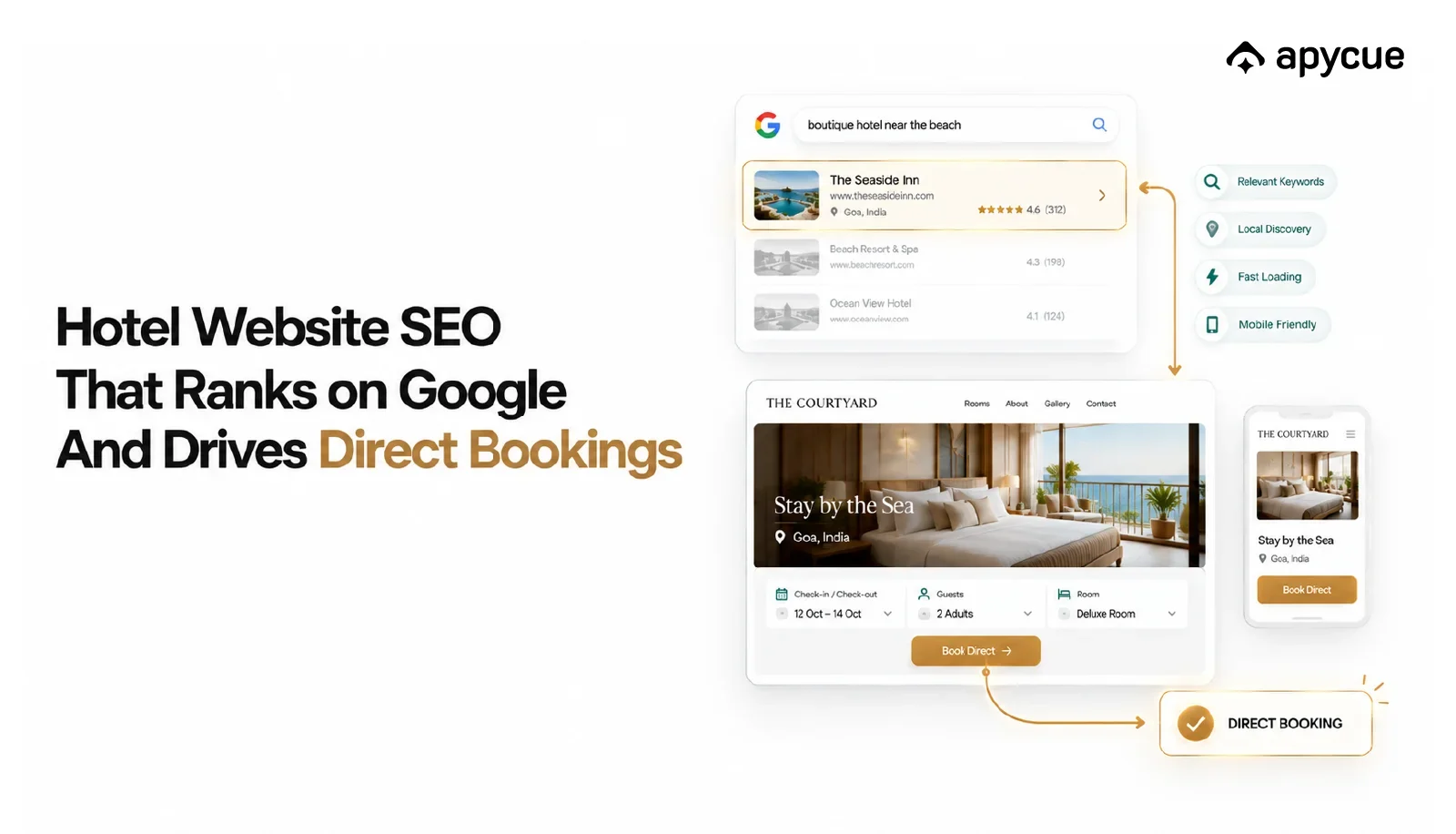
This guide covers every part of hotel website SEO in plain language. Whether you run a boutique property, a resort, a business hotel, or a chain of properties, the same principles apply. We will walk through keyword research, on-page SEO, local SEO, page speed, mobile optimisation, content strategy, and backlinks. By the end, you will know exactly what to fix and in what order. Hotels that want more direct bookings from their own website need to start here.
Is your hotel website invisible on Google?
Get a free website audit. We will show you exactly what is holding your site back from ranking.
Book a Free CallWhat is Hotel Website SEO and Why Does it Matter?
Hotel website SEO is the process of making your hotel's website appear higher in Google search results when potential guests search for accommodation. When someone types "hotel near city centre" or "boutique hotel with pool" or "best resort for families in [destination]", your hotel website SEO determines whether your property shows up on page one, page three, or not at all.
It matters because organic search is one of the highest-intent, lowest-cost booking channels available to any hotel. Guests who find you through Google are actively looking to book accommodation. They are not scrolling past an ad. They searched, found you, and landed on your site. If your website converts, that booking costs you nothing in commission.
The alternative is dependence on OTAs. OTAs are good at SEO. They have enormous budgets, vast content libraries, and strong domain authority. Every booking that goes through them instead of your own website is a commission payment you did not need to make. Hotel website SEO is how you compete for those guests before the OTAs can intercept them.
The 7 Core Areas of Hotel Website SEO
1. Keyword Research for Hotels
Keyword research means finding the exact search terms your potential guests use when looking for accommodation like yours. It is the foundation of every other SEO decision you make. Choose the wrong keywords and all the other work is wasted.
For hotels, keyword research falls into three categories. The first is destination keywords: "hotels in [city]", "accommodation near [landmark]", "where to stay in [destination]". These have high search volume and high competition from OTAs, but a well-optimised hotel website can still rank for longer, more specific versions of these terms.
The second is property-type keywords: "boutique hotel with pool", "family resort with kids club", "business hotel near airport", "pet-friendly hotel in [city]". These are lower volume but much higher intent. A guest searching this way knows exactly what they want and is closer to booking.
The third is experience keywords: "best hotel for honeymoon in [destination]", "hotels with spa and fine dining", "rooftop bar hotels in [city]". These attract guests who are comparing options based on what they want to do, not just where to sleep.
How to do it: Start by listing every feature, amenity, and location advantage your property has. Then build search terms around each one. Use Google's own autocomplete suggestions when you type into the search bar. Look at what terms your existing competitors appear to rank for by reading their page titles and headings. The goal is to find terms that have enough search volume to matter but are specific enough that an OTA's generic listing page does not perfectly satisfy the intent.
2. On-Page SEO for Hotel Websites
On-page SEO is everything on the page itself that tells Google what that page is about. For hotels, every key page on your website needs on-page SEO treatment: your homepage, your rooms and suites pages, your dining and spa pages, your location page, and your booking page.
The essential elements of on-page SEO for every hotel page are as follows. The title tag is the clickable headline that appears in search results. It should include your primary keyword for that page and your hotel's name. For example: "Deluxe Sea View Rooms | [Hotel Name] | [City]". Keep it under 60 characters.
The meta description does not directly affect rankings but it determines whether guests click. Write one sentence that tells the guest exactly what they will find on the page and what makes your hotel worth clicking. Include a relevant keyword naturally.
The H1 heading is the main on-page headline. Every page should have exactly one H1 that includes the primary keyword. Supporting headings (H2 and H3) should organise the content and include secondary keywords where they fit naturally.
Body content should describe your property, rooms, amenities, and location in genuine detail. Thin pages with only a handful of sentences do not rank. Each important page needs enough content to genuinely answer a guest's question. Image alt text is another often-missed element. Every photo on your hotel website should have a descriptive alt tag that helps Google understand what the image shows and adds keyword relevance.
Finally, internal linking matters. When a page on your website is set up to convert direct bookings, every other relevant page should link to it, so both guests and Google can find it easily.
Not sure if your hotel pages are SEO-ready?
Get a free website audit and find out exactly what needs fixing.
Book a Free Call3. Local SEO for Hotels
Local SEO is about making your hotel visible when guests search for accommodation in a specific location. It controls whether your property appears in the Google Maps pack (the map with three listings that appears at the top of local search results) and in location-based organic results.
The foundation of hotel local SEO is your Google Business Profile. This is the panel that appears on the right side of search results when someone searches for your hotel by name, and what powers your appearance in Google Maps. If your profile is incomplete, out of date, or full of incorrect information, you are invisible in local search. Fill in every section: property name, address, phone number, website, check-in and check-out times, amenities, photos, and property category. Update it whenever anything changes.
Reviews are a significant local ranking signal. Hotels with more positive, recent Google reviews rank higher in local results and get clicked more often. Make getting reviews part of your standard guest journey. A simple request at checkout or a follow-up message after the stay drives a steady stream of reviews without pressure. For a full strategy, read our guide on how to get more Google reviews for your hotel.
Beyond your Google Business Profile, local SEO for hotels includes getting your hotel listed consistently across all major directories and booking platforms. NAP consistency (name, address, phone number) across every platform where your hotel appears is a trust signal for Google. Conflicting information hurts rankings. A hotel booking page integrated into your own site, with your full address and local details on every page, also reinforces your local relevance to search engines.
4. Page Speed and Technical SEO
Page speed is a confirmed Google ranking factor. A hotel website that loads slowly ranks lower and converts fewer guests. This is not a trade-off. Both rankings and conversions suffer from the same root cause: a slow website.
The standard benchmark is under three seconds on mobile. Most hotel websites fail this. Image-heavy sites with large, uncompressed photos, heavy slider plugins, and outdated code typically load in five to eight seconds or more on a mobile connection. Google's own data shows that most users abandon a page that takes longer than three seconds to load. For hotels, that means potential guests are leaving before they see your rooms.
Use Google PageSpeed Insights to test your hotel website right now. The tool gives your site a score out of 100 for both mobile and desktop and lists specific issues to fix, ranked by impact. The most common fixes for hotel websites are compressing and converting images to modern formats, removing or deferring scripts that are not needed on page load, enabling browser caching, and reducing the number of third-party tools loading on every page.
Technical SEO beyond speed includes ensuring your site is crawlable (Google can find and read every page), that you have a proper XML sitemap submitted to Google Search Console, that every page has a canonical tag to avoid duplicate content issues, and that your site uses HTTPS. These are not optional. A technically broken website cannot rank well regardless of how good the content is.
Is your hotel website too slow to rank?
We build hotel websites that load fast and convert direct bookings.
Book a Free Call5. Mobile SEO for Hotels
Google uses mobile-first indexing, which means it looks at your mobile website first when deciding how to rank you. If your mobile experience is poor, your rankings suffer even for guests on desktop. For hotels, this matters more than almost any other industry because a large and growing share of hotel browsing happens on mobile devices.
Mobile SEO goes beyond simply having a responsive design. A responsive site adjusts to screen size, but that does not mean it is a good mobile experience. Key mobile SEO factors for hotels include: tap targets (buttons and links) being large enough to use on a small screen; text being readable without pinching and zooming; forms being easy to complete on mobile (a booking form that requires too many steps on a small screen loses bookings); and images loading at the right size for the screen rather than loading a full desktop-size image and scaling it down.
Hotels with slow or frustrating mobile experiences see higher bounce rates and lower conversion from mobile traffic. This compounds the SEO problem because Google uses engagement signals. If guests quickly leave your mobile site, that signals poor quality and your rankings fall further. Every point of friction on your mobile site is a guest who goes back to an OTA and converts fewer bookings through your direct channel.
6. Content SEO for Hotels
Content SEO means creating genuinely useful pages and articles that answer questions guests are asking. It is how hotels compete for informational searches that occur before a guest has chosen their destination or property. Done well, content SEO brings in guests at the top of the funnel and guides them toward a direct booking.
The types of content that work for hotel SEO include destination guides (things to do near the hotel, local area guides, seasonal event guides), experience-focused pages (honeymoon packages, family travel guides, business travel tips for your area), and practical information pages (parking, transport, airport transfers, nearby attractions). These pages target the questions guests ask before they book accommodation, and they position your hotel as the authority on your destination.
The key to content SEO is consistency. A single blog post published once does not move rankings. A regular schedule of quality content, each page targeting a specific keyword or question, builds authority over time. Hotels that publish useful destination content consistently over six to twelve months see sustained growth in organic traffic that no paid channel can replicate.
7. Backlinks for Hotel Websites
A backlink is a link from another website to yours. Google treats backlinks as votes of credibility. A hotel website with links from reputable travel publications, tourism boards, local business directories, and hospitality industry sources has higher domain authority and ranks better than one with no external links pointing to it.
For hotels, the most natural and effective backlinks come from: getting listed on tourism board websites and local destination marketing organisation sites; being featured in travel publications, travel blogs, and local news when you run events, open new facilities, or offer something newsworthy; being listed in quality hospitality industry directories such as Hospitalitynet; and partnerships with local attractions, restaurants, or experience providers who link to you from their own websites.
Link building for hotels does not require complex outreach campaigns. Start with the directories and tourism board listings that you can control. Then, over time, create content worth linking to. A genuinely useful local area guide or a well-researched article about your destination gets shared and linked to naturally.
How Apycue Helps Your Hotel Get More Direct Bookings Through SEO
Apycue was built specifically for hotels that want to reduce their dependence on OTAs and grow direct bookings through their own website. Every part of Apycue's platform is designed around the SEO and conversion requirements of the hospitality industry.
Apycue's hotel website SEO services cover every layer of what this guide describes.
Hotel Website SEO Audit: Before fixing anything, you need to know exactly what is broken. Apycue's website audit identifies the specific issues holding your hotel website back from ranking: missing or weak on-page SEO, slow load times, local SEO gaps, mobile experience problems, and technical issues that prevent Google from properly indexing your site. You get a clear, prioritised list of what to fix.
On-Page SEO Setup: For hotels building a new website with Apycue, every page is built with on-page SEO from the start. Title tags, meta descriptions, heading structure, image alt text, internal linking, and schema markup are all configured correctly before the site goes live. For hotels with existing websites, Apycue can audit and rewrite the SEO setup across all key pages.
Local SEO Optimisation: Apycue helps hotels claim, complete, and optimise their Google Business Profile and ensures NAP consistency across all major platforms and directories. This is often the fastest route to increased visibility in local search, particularly for hotels in competitive destinations.
Content SEO Strategy: Apycue builds content plans around the keywords your potential guests are actually searching. This includes identifying the destination content, experience pages, and informational articles that will bring in organic traffic from guests who have not yet committed to a property. Each piece of content is built around a specific keyword target and structured for both readability and search performance.
Ongoing SEO Management: SEO is not a one-time project. Rankings require consistent attention, content publishing, and performance monitoring. Apycue provides ongoing SEO management for hotels that want sustained growth in direct bookings without managing the process themselves.
How Long Does Hotel SEO Take to Show Results?
This is the question every hotel asks, and the honest answer is: it depends on where you are starting from and how competitive your market is. As a general guide, most hotels see the following timeline.
In the first one to three months, technical fixes and on-page SEO improvements are implemented. Google begins to re-crawl and re-index pages. Local SEO changes start to show in Google Maps results. Some early movement appears on lower-competition keywords and long-tail terms.
Between three and six months, organic traffic typically begins to show measurable growth. Pages that were targeting the right keywords but lacking optimisation start to climb. Content published in the first month begins to rank for the specific questions it was written to answer.
From six to twelve months, compounding results become clear. Hotels that have published consistently, built a small number of quality backlinks, and maintained their on-page and technical SEO see sustained traffic growth. Direct bookings from organic search increase. The OTA commission spend that would have covered those bookings stays in the hotel's revenue.
Beyond twelve months, the asset compounds. Every page that ranks continues to bring in organic traffic without additional spend. Hotels that invest in SEO early build a sustainable direct booking channel that outperforms paid advertising on a cost-per-booking basis over any meaningful time horizon.
What to Fix First: Priority Order for Hotel Website SEO
If you are looking at your hotel website and do not know where to start, use this priority order.
First, fix your Google Business Profile. If it is incomplete, out of date, or has incorrect information, fix it today. This is the fastest way to improve local visibility and has no technical prerequisites.
Second, fix page speed. Run your site through Google PageSpeed Insights and address the highest-impact issues. If your site scores below 50 on mobile, speed is costing you both rankings and bookings right now.
Third, fix on-page SEO on your most important pages. Start with your homepage and your rooms pages. Write proper title tags, meta descriptions, and H1 headings for each. Make sure the content on each page is substantial enough to rank.
Fourth, start getting Google reviews. Put a simple review request process in place. Reviews compound over time, and the sooner you start the sooner you see the local SEO benefit.
Fifth, begin content SEO. Identify two or three destination or experience keywords your hotel should rank for. Publish one well-written, genuinely useful page targeting each one. Repeat consistently.
Everything else follows from these five priorities. Once they are in place, backlinks, advanced technical SEO, and content scaling will compound the results you have already built.
Frequently Asked Questions
Hotel website SEO (Search Engine Optimization) is the process of improving your hotel website so it appears higher in Google search results when guests search for accommodation in your location. It includes keyword research, on-page SEO, local SEO, page speed optimization, mobile optimization, content publishing, and backlink building.
Most hotels see initial movement within three to six months of consistent SEO work. Meaningful organic traffic and direct booking growth typically comes within six to twelve months. SEO is a long-term investment — the results compound over time and continue delivering bookings without paying commission on each one.
The most common reasons are: missing or incomplete Google Business Profile, slow page speed, poor on-page SEO setup (missing title tags, meta descriptions, and H1s), no location-specific pages, and very few or no backlinks. An SEO audit will identify exactly which of these is holding your site back.
Yes. Google uses page speed as a confirmed ranking factor, particularly for mobile search. A hotel website that loads in over three seconds loses both rankings and bookings — most guests abandon slow pages before they even see your rooms. Use Google PageSpeed Insights to check your score and fix the biggest issues first.
Local SEO means optimising your hotel's online presence so it appears when guests search for accommodation in your specific area — including on Google Maps. The foundation is a complete and accurate Google Business Profile. Local SEO also includes consistent NAP (name, address, phone) details across all platforms and location-specific pages on your hotel website.
Yes. Apycue provides hotel SEO services including website SEO audits, on-page SEO setup, local SEO optimisation, content SEO strategy, and ongoing SEO management. Every website Apycue builds is also SEO-ready from day one — fast loading, mobile-first, and structured for direct booking conversions.
Paid ads deliver immediate traffic but stop the moment you stop paying, and costs rise over time as more competitors bid on the same keywords. SEO takes longer to build but creates a compounding asset — search visibility that keeps delivering direct bookings for years with no additional spend per booking. The smartest hotel marketing strategy uses both together.
Ready to reduce your OTA dependence for good?
Start with a free website audit. See exactly where your hotel is losing rankings and direct bookings.
Book a Free CallShare this post