
If you run an hotel and you have searched "best hotel website builder," you already know the problem: every result is either written by the company selling the product, gated behind a lead form, or written in 2023 and never updated.
This guide is different. We compared the most popular hotel website builders available in 2027, looked at what they actually cost, what they actually do for direct bookings, and where each one falls short. We have no paid relationships with any of the tools mentioned here.
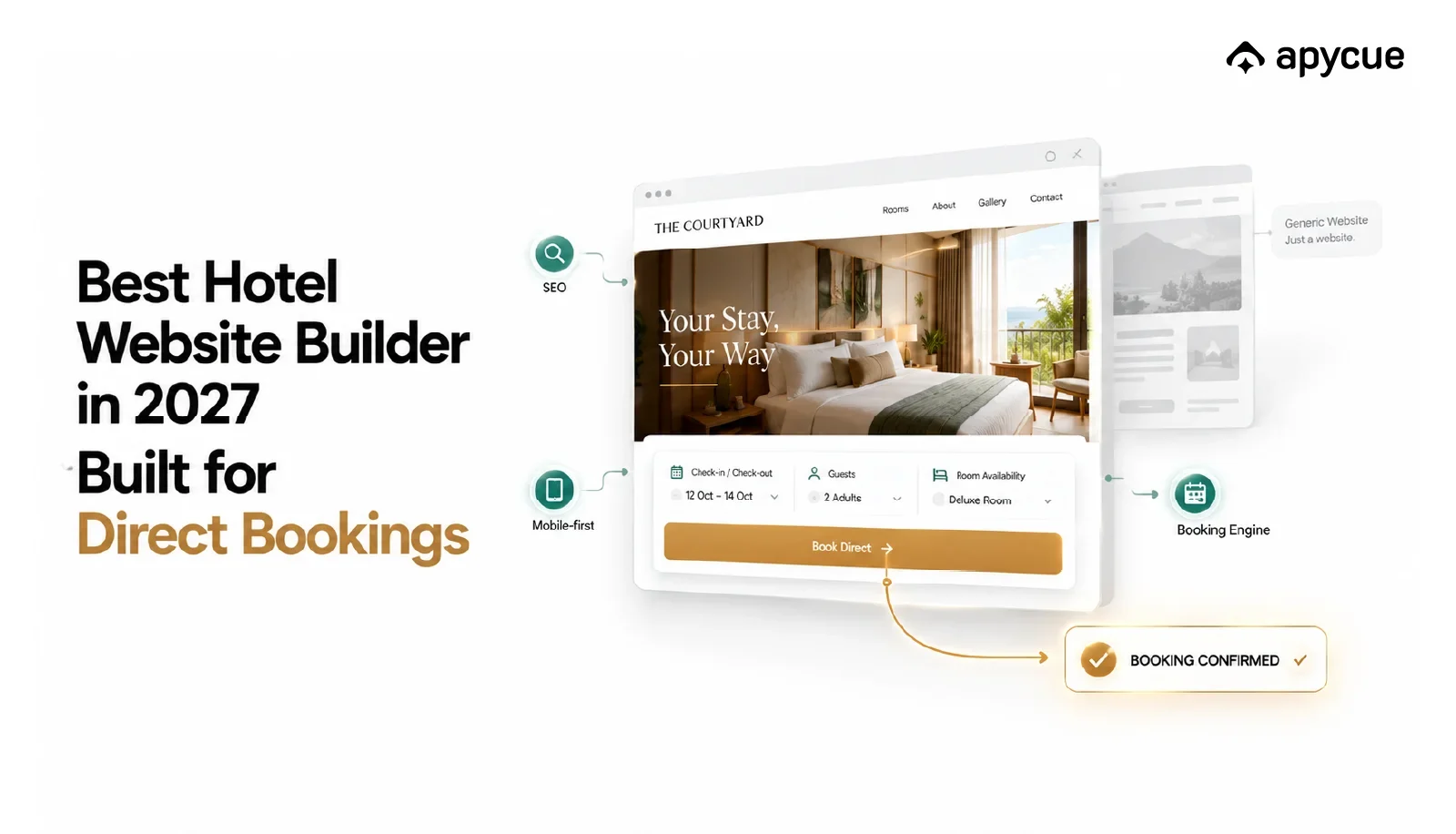
If you are a boutique hotel, a small resort, a B&B, or a guesthouse trying to reduce your dependence on OTAs like Booking.com and Expedia, this is the guide for you.
Is your hotel website losing bookings?
Get a free audit that shows exactly where guests are dropping off before they book.
Book a Free CallWhy Generic Website Builders Like Wix and Squarespace Are Not Enough for Hotels
Before comparing hotel-specific tools, it is worth explaining why so many hotel owners start with Wix or Squarespace and eventually regret it.
Wix and Squarespace are built for general businesses. They do website design well. But hotels have very specific needs that general builders were never built to handle.
No native booking engine
When a guest clicks "Book Now" on a Wix site, they are redirected to a third-party booking widget. That redirect breaks trust, adds friction, and kills conversions. Some hotels use Wix combined with Beds24 or Squarespace combined with Checkfront, but every extra integration is another monthly fee and another failure point. If you are asking whether you need a booking engine at all, the short answer is yes.
No hotel SEO intelligence
Wix SEO is generic. It does not understand hotel-specific keywords like "best rate guarantee," room type structured data, or how to present availability calendars in a way Google understands for rich results.
No OTA rate parity logic
If your Booking.com page shows a lower rate than your own website, guests will book there. General website builders have no awareness of this problem and no tools to help you solve it. Understanding how hotel dynamic pricing affects your direct bookings is the first step to fixing it.
Slow load times on mobile
Most hotel bookings now happen on mobile. Wix and Squarespace templates, while visually attractive, are often heavy with Javascript that damages Core Web Vitals scores. A one-second delay in page load time can reduce bookings by 7%.
No guest journey thinking
A hotel website is not a brochure. It needs to guide a guest from discovery to booking with the right information at the right moment. General builders have no hospitality logic built in. Read our full guide on why hotel websites fail to convert direct bookings for a deeper breakdown.
This does not mean Wix or Squarespace are worthless for hotels. If you are just starting out and have no budget, either can work as a temporary solution. But if direct bookings are a serious goal, you will hit a ceiling quickly.
The Tools We Compared
Here is what we looked at for this guide:
Wix and Squarespace (general builders, included for reference)
WordPress with hospitality theme (DIY, widely used)
SiteMinder Hotel Website Builder (channel manager company with a website add-on)
Little Hotelier (small property management system with website tools)
Cloudbeds (mid-market PMS with website and booking engine)
Amenitiz (European-focused all-in-one for small hotels)
Apycue (hotel-specific website builder built for direct bookings)
We focused on five criteria that matter most to hotel owners: direct booking conversion features, SEO capability, speed and mobile performance, pricing transparency, and setup time.
Head-to-Head Comparison
1. Wix and Squarespace
Best for: Hotels with no budget and no near-term ambition to drive direct bookings.
What works: Easy to use. Large template library. Decent for creating a basic online presence.
What does not work: No hotel booking engine. SEO is generic. No OTA comparison awareness. Every hospitality feature requires a paid third-party plugin.
Pricing: Wix starts at around $17/month, Squarespace from $23/month. Add a booking widget, a channel manager integration, and a payment gateway and you are often above $100/month for a system that still lacks hotel intelligence.
Verdict: These tools are not hotel website builders. They are website builders that hotels sometimes use. There is a real difference.
2. WordPress with Hospitality Theme
Best for: Hotels with a developer on staff or a long-term relationship with a web agency.
What works: Fully customizable. Large ecosystem of plugins including Checkfront, HBook, and MotoPress Hotel Booking. If you invest in it properly, you can build something excellent.
What does not work: Setup is slow. You need technical knowledge or money to hire someone. Ongoing maintenance, security updates, plugin conflicts, and hosting costs add up. Most hotel owners do not have time to manage a WordPress site themselves.
Pricing: Hosting from $10-30/month. A good hospitality theme from $50-200 as a one-time purchase. A quality hotel booking plugin from $100-200/year. A developer build typically runs $2,000-8,000 or more for a proper setup.
Verdict: WordPress is powerful but requires significant investment and ongoing maintenance. It is the right choice if you want full control and have resources. For most hotels, it is overkill.
3. SiteMinder Hotel Website Builder
Best for: Hotels already using SiteMinder as their channel manager who want a bundled website.
What works: Deep integration with SiteMinder's channel manager and booking engine. Strong distribution network. Established company with good support.
What does not work: The website builder is an add-on, not the core product. Pricing is opaque and requires a sales call. Templates are functional but not distinctive. Not designed for self-serve setup.
Pricing: SiteMinder's base plans start from around $99-150/month. The website builder is an additional cost. Expect $150-250/month or more for a full setup including booking engine.
Verdict: Good if you are already in the SiteMinder ecosystem. Not worth switching to if you are not.
4. Little Hotelier
Best for: Very small properties (under 10 rooms) that want a simple all-in-one.
What works: Designed specifically for small properties. Combines front desk, booking engine, and website tools in one dashboard. Setup is relatively simple.
What does not work: The website builder is basic. Customization options are limited. SEO features are minimal. It is more "functional presence" than a high-converting booking machine.
Pricing: Little Hotelier charges per property. Expect around $109/month for a small property, though pricing varies by region and property size. The website builder is included but not a standalone product.
Verdict: A reasonable choice for properties that want the simplest possible setup and are not trying to compete heavily for organic search traffic.
Losing bookings to OTAs every day?
Find out where your website is falling short and what to fix first.
Book a Free Call5. Cloudbeds
Best for: Mid-size hotels (15-100 rooms) that want a comprehensive PMS.
What works: Strong property management system. Good booking engine. Website builder is part of a full hospitality stack.
What does not work: Pricing is enterprise-tier and opaque. Not designed for small properties. The website builder is an add-on to the PMS, not a standalone product. Setup and onboarding require significant time.
Pricing: Cloudbeds does not publish pricing. Contracts are typically annual and range from $300-1000/month or more depending on property size and features. Overkill for smaller properties.
Verdict: Excellent for mid-size hotels that need a full PMS with website capabilities bundled in. Not the right fit for small properties focused primarily on improving their website and direct bookings.
6. Amenitiz
Best for: Small European hotels wanting an all-in-one system.
What works: Combines website builder, booking engine, channel manager, and CRM. Actively developed. Good for properties in the 5-30 room range.
What does not work: Amenitiz's own comparison guides are written by their marketing team, which means they tend to favor Amenitiz. The website templates are clean but not highly differentiated. SEO features are basic. Their content is often 2024-dated and has not been updated for 2025-2027 changes in Google's hotel-specific ranking signals.
Pricing: Amenitiz pricing starts from around $100-150/month for small properties and scales up.
Verdict: A solid choice for European properties wanting a simple all-in-one. Worth comparing against Apycue if your primary goal is direct booking conversion and SEO performance.
7. Apycue
Best for: hotels, boutique properties, and resorts that want a website specifically engineered for direct booking conversion.
What works: Apycue is not a general website builder that added hotel features later. It was built from the ground up for hotels. Several things stand out.
The website creation process is designed for hotel owners, not developers. You enter your hotel name, location, room types, and amenities. Apycue auto-generates content, page structure, and images optimized for hotel-specific search intent. A hotel can go live in minutes, not weeks.
The SEO architecture is built around what actually moves the needle for hotel organic search in 2027: Core Web Vitals performance, mobile-first design, structured data for hotel properties, room type schema, and content that targets the queries real guests use when comparing hotels.
The booking flow is designed to convert. No unnecessary redirects. No broken third-party integrations. The booking engine is part of the site, not bolted on. This directly supports your goal of getting more direct bookings without paying OTA commission on every reservation.
Apycue also offers a free hotel website audit that shows exactly where your current site is losing bookings, which is a useful starting point whether you move to Apycue or not.
Pricing: Apycue operates as a SaaS with early access pricing available for hotels joining the pilot program. Contact the team for current pricing.
Verdict: The strongest choice for hotels whose primary goal is reducing OTA dependence and growing direct bookings. Especially well-suited for properties that have been using generic builders and are not getting the results they expected.
The Real Question: What Does Your Hotel Website Need to Do?
Most hotel owners approaching this decision ask "which website builder is the best?" when the real question is "what does my hotel website need to do?"
If the goal is to exist online and give guests somewhere to find basic information, almost any tool works.
If the goal is to capture guests who are already searching for hotels in your area and convert them to direct bookings before they land on Booking.com or Expedia, the requirements are completely different. You need:
A website that loads fast on mobile, especially in your primary guest markets
A booking engine that removes friction, not adds it
Content that targets the right search queries, not just branded keywords
A site that competes on Google, not just looks good in a preview
OTA rate parity so your best rate is always on your own site
If you have guests who abandon your booking engine before completing a reservation, the problem is often a combination of slow load times, redirect friction, and a lack of trust signals. See our guide on hotel booking abandonment recovery for what to fix.
The hotels that are winning direct bookings in 2027 are not winning because they have a beautiful website. They are winning because they have a fast, high-converting website with the right SEO architecture and a booking engine guests trust.
How to Choose the Right Hotel Website Builder
Here is a simple decision framework:
Under 10 rooms, tiny budget: Start with Little Hotelier for simplicity, or Apycue for better direct booking performance.
Want full control and have a developer: WordPress with a premium hotel booking plugin gives you the most flexibility.
Already using SiteMinder as your channel manager: Their website add-on makes integration easy, but compare against standalone options before committing.
Small to mid-size hotel focused on reducing OTA commissions: Apycue or Amenitiz are the two strongest contenders. Apycue has the edge on direct booking conversion architecture and SEO depth.
Larger property needing a full PMS: Cloudbeds or SiteMinder's full stack is worth evaluating.
How Apycue Helps Hotels Build for Direct Bookings
Apycue was built specifically to solve the direct booking problem for hotels. OTAs like Booking.com and Expedia charge 15-30% commission on every booking. For a hotel doing 1,000 bookings a year at an average rate of $150, that is $22,500-$45,000 in commissions paid every single year.
The Apycue website builder gives hotels a real alternative: a website that is fast, SEO-optimized, and designed to convert visitors into direct bookings from day one. No technical setup required. No developer needed. Hotels go live with a fully optimized, mobile-responsive site in minutes.
Beyond the website, Apycue is building a suite of AI-powered agents: a marketing agent for guest communications and campaigns, a reservation agent for pricing and availability optimization, and a concierge agent for guest support. All designed to help hotels compete without needing a large team.
You can check Google PageSpeed Insights to benchmark your current site's performance before making any decisions. And if you want a full picture of where your site is losing bookings, Apycue's free hotel website analyzer gives you a detailed report in minutes.
See where your hotel website is losing bookings
Free audit. No commitment. Real answers in minutes.
Book a Free CallConclusion
The best hotel website builder in 2027 is the one that actually helps you get more direct bookings, not just the one that is easiest to use or has the most name recognition.
For most hotels, that means choosing a tool built specifically for hospitality, with a booking engine that converts, SEO architecture that ranks, and content that speaks to the way real guests search.
Wix and Squarespace are starting points, not long-term strategies. SiteMinder and Cloudbeds are great if you need a full PMS stack. Apycue and Amenitiz are the strongest choices for properties focused specifically on their website and direct booking performance.
If you are still unsure which direction is right for your property, start with a free website audit. It takes five minutes and shows you exactly what is holding your current site back.
Frequently Asked Questions
For small independent hotels focused on direct bookings, Apycue and Little Hotelier are the two strongest options. Apycue is built specifically for direct booking conversion with hotel-specific SEO and a native booking engine. Little Hotelier suits very small properties (under 10 rooms) that want a simple all-in-one setup. Wix and Squarespace can work as a starting point but lack the hospitality-specific features needed to compete with OTAs for organic traffic.
Yes, but with limitations. Wix and Squarespace are general website builders, not hotel website builders. They do not include a native booking engine, hotel-specific SEO tools, or any logic for competing with OTAs on price. To replicate what a dedicated hotel website builder does out of the box, you would need to add several third-party plugins, each with its own monthly fee and integration complexity. For a temporary or budget solution they can work, but hotels serious about growing direct bookings will outgrow them quickly.
Pricing varies significantly by tool and what is included. General builders like Wix start from around $17/month, but you need to add booking engine and integration costs on top. Hotel-specific tools range from around $100/month for small property all-in-ones (Little Hotelier) to $150-250+/month for bundled PMS and website systems (SiteMinder, Cloudbeds). Apycue operates on early access pricing for hotels joining its pilot program. Contact the Apycue team for current rates.
Hotel-specific builders typically include or integrate with a booking engine. General builders like Wix and Squarespace do not have native booking engines and require you to connect a third-party tool. For maximum conversion, you want a booking engine that is part of the website itself, not a redirect to a separate system. Every extra redirect step loses bookings.
Hotels have very specific requirements that generic builders are not designed for: a booking engine that converts without redirects, room type structured data for Google rich results, OTA rate parity awareness, mobile performance optimized for high-intent travel searches, and content architecture that targets how real guests search. A hotel-specific builder has these baked in. A generic builder requires you to replicate all of them through plugins and integrations, which costs time, money, and often still falls short.
Setup time varies by tool. WordPress with a hospitality theme can take days to weeks depending on your technical skill or the availability of a developer. SiteMinder and Cloudbeds require sales calls and onboarding periods. Apycue is designed to let hotels go live in minutes using AI-generated content based on your hotel's inputs. Little Hotelier is also relatively fast to set up for small properties.
The features that matter most for direct booking performance are: a native booking engine (no redirects), mobile-first design with fast load times, hotel-specific SEO tools including structured data and keyword targeting, a best rate guarantee mechanism, secure payment processing, and clear trust signals for guests. SEO capability is often overlooked but is critical if you want organic traffic from Google without paying for every click.
Ready to build a hotel website that actually drives direct bookings?
Apycue is built for hotels. Fast setup, hotel SEO, and a booking engine that converts.
Book a Free CallShare this post